1.800.668.3752
Call us for a free quote
Call us for a free quote

Here’s a number that should get your attention: productivity losses during an office relocation average $2,000 to $3,000 per employee for each day of downtime.¹
Let that sink in. For a 50-person company, that’s $100,000 to $150,000 in lost productivity per day.
The difference between companies that absorb those losses and companies that don’t usually comes down to one thing: planning. Not the “we should probably start thinking about this” kind of planning. The kind that starts months before anyone packs a single box.
According to recent research, companies that allow at least 12 months for relocation planning report 31% higher satisfaction with their move outcomes.¹ That’s not a minor improvement. That’s the difference between a move that disrupts your business and one that actually positions it for growth.
A survey by Knotel found that 93% of executives have experienced at least one office move during their tenure, and 95% reported some level of distraction.² Even more telling: 64% labeled their move as either a major or moderate distraction to business operations.
The top issues employees report? Distractions during the transition, longer commutes, and overall loss of productivity. These aren’t minor inconveniences—they’re the kinds of disruptions that affect client relationships, project timelines, and team morale.
But here’s what’s interesting: these problems are almost always preventable. They stem from compressed timelines, poor communication, and underestimating the complexity of coordinating furniture, technology, and people simultaneously.
The commercial moving industry is now worth over $23 billion, and the corporate relocation services market is projected to reach $20.22 billion in 2025.³ Companies are investing heavily in professional relocation support because they’ve learned the hard way what happens when they don’t.
Most companies budget for the obvious expenses—movers, trucks, maybe some new furniture. But the real budget killers hide in places you don’t expect.
IT infrastructure alone can account for 20-25% of total relocation costs.¹ Server rooms, cabling, network setup, phone systems—these aren’t afterthoughts. For a mid-sized office, technology-related moving expenses can run anywhere from $5,000 to $30,000.⁴
Then there’s the cost of downtime itself. Beyond lost productivity, you’re looking at potential revenue loss from delayed projects, missed deadlines, and frustrated clients who can’t reach you during the transition.
And here’s one that catches companies off guard: employee turnover. Research shows that office moves increase voluntary departures by 12-15% when commute times increase by more than 30 minutes.¹ Losing even a few key employees during a move can set your operations back months.
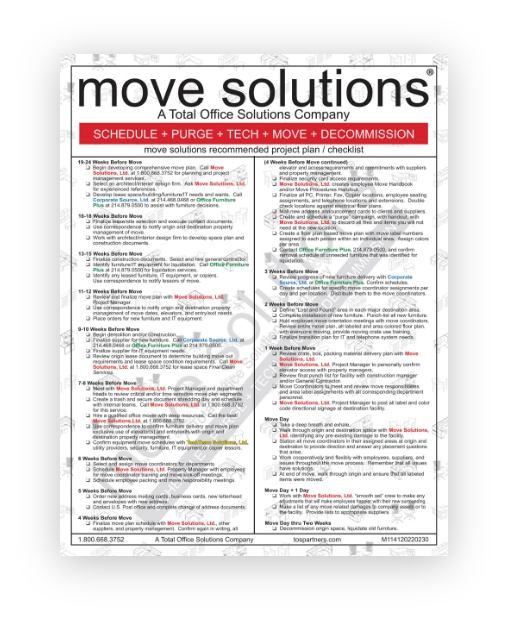
For Dallas-Fort Worth businesses planning a commercial move, the timeline matters more than most realize. Here’s what proper pre-move planning includes:
6-12 months out: Site selection, lease negotiations, and assembling your move team. This is when you’re making decisions that will affect every phase that follows. Rushing this stage is where most moves go wrong.
3-6 months out: Detailed inventory of everything that’s moving—and everything that isn’t. This is also when IT planning should be in full swing. Your technology infrastructure needs to be operational the moment employees walk into the new space, not three days later.
1-3 months out: Vendor coordination, employee communication, and logistics planning. Professional commercial movers should be locked in, floor plans finalized, and every department should know exactly what’s expected of them.
Final weeks: Packing non-essential items, final IT preparations, and move-day coordination. If you’ve planned well, this phase is execution, not crisis management.
ategy that consistently reduces downtime: moving in phases rather than all at once. By relocating departments in stages, you maintain operational continuity while each team transitions.
For example, back-office functions might move first while customer-facing teams stay operational. Once IT systems are tested and running in the new space, client services can follow. This staggered approach prevents the complete shutdown that single-day moves often require.
Companies across Texas—from downtown Dallas to the DFW suburbs—are increasingly adopting phased relocation strategies, particularly for moves involving complex technology infrastructure or 24/7 operations.
Here’s the math that makes pre-move planning worth every hour you invest: companies that provide strong relocation support report 31% higher employee satisfaction and 23% faster recovery in productivity after the move.¹
That faster recovery alone can translate to tens of thousands of dollars in preserved revenue. Add in reduced employee turnover, fewer IT disasters on day one, and the avoided costs of emergency vendor calls, and strategic planning isn’t an expense—it’s an investment with measurable returns.
The companies that treat their office moves as strategic projects rather than logistical inconveniences are the ones that come out stronger on the other side.
Move Solutions specializes in commercial office relocation for businesses across Dallas-Fort Worth and nationwide. From pre-move planning and project management to furniture installation and IT coordination, we handle every phase of your office move so you can focus on running your business. Contact us at 1.800.668.3752 to start planning your relocation.
Sources