1.800.668.3752
Call us for a free quote
Call us for a free quote
Dallas-Fort Worth landed another top ranking in April 2026: most corporate headquarters relocations of any U.S. metro, for the seventh year running. According to CBRE’s 2026 Shifting Landscape of Headquarters Relocations report, DFW captured 11 interstate or international HQ moves in 2025 — ahead of Miami, Austin, Charlotte, and New York. Another seven companies moved within the metro, for a combined 18 HQ relocations in the region in a single year.
Behind every one of those new offices is a physical, thousands-of-boxes-and-workstations move that has to happen on a deadline without interrupting the business.
While the strategic decision to relocate gets the coverage, the execution doesn’t. But the execution is where most of the money gets spent, most of the risk lives, and most of the preventable mistakes happen. Here’s what the 2026 data — and the commercial real estate pros tracking it — say about what matters when a corporate move gets real.
Corporate move planning typically starts three to four months before the target move date. Commercial real estate advisors who work on HQ relocations routinely describe that window as too short.
The reason: a corporate headquarters relocation isn’t one project, it’s about a dozen parallel ones, and the critical path is almost never the physical move itself. It’s usually some combination of landlord approvals at the destination, low-voltage cabling, furniture lead times, IT infrastructure provisioning, and — for interstate relocations — payroll, tax registrations, and employee transitions.
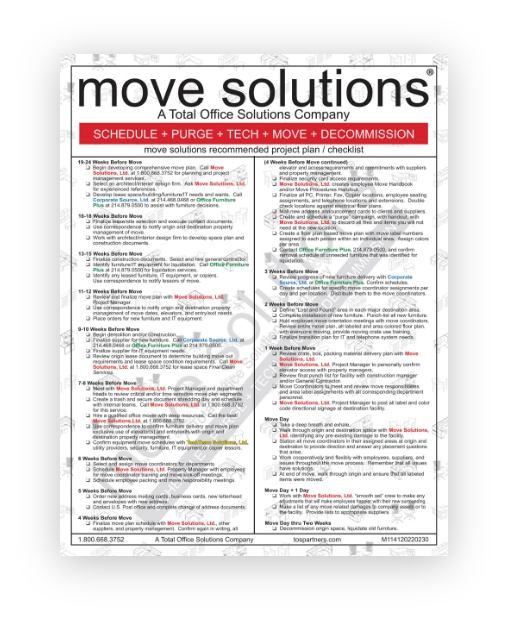
A realistic timeline for a full HQ relocation looks something like this:
Companies that miss this timeline tend to do so because they treat the move as the last item on the checklist. It’s actually the thread that runs through everything else. Furniture can’t ship until the space is ready. The space isn’t ready until cabling is done. Cabling can’t be scheduled until the landlord approves the buildout. The mover can’t plan the sequence until the furniture installer’s dates are locked.
Every phase upstream compresses the phase downstream. The move execution itself is the buffer that absorbs all the slippage from everything that came before.
About 60% of DFW’s 2025 HQ wins were interstate. Per the CBRE report, most of those came from Chicago, New York, San Francisco, and Los Angeles — all high-cost metros with dense offices and complicated real estate.
Interstate HQ relocations add layers that a local move doesn’t have:
Staggered timelines at origin and destination. The old lease termination date rarely matches the new space’s ready date. That means temporary storage, phased moves over weeks, or a period of overlapping rent. Many companies underestimate the cost and complexity of bridging that gap.
Employee relocation is its own project. Of a 400-person HQ, 60-70% of employees typically make the move in a relocation from California or the Northeast to Texas — the rest are hired at the new location. Every personnel decision affects what physically has to be moved: which desks, which equipment, whose files. Those decisions get made in HR meetings on a different timeline than the move plan, and the two tracks need to be reconciled.
Certified destruction of records that can’t travel. Regulated documents, client files under specific jurisdictions, and pre-discovery materials in active litigation often can’t cross state lines without legal review. That means certified shredding and disposal at origin, chain-of-custody documentation, and destruction certificates. If legal hasn’t weighed in before pack day, the move stalls.
IT deployment before move day. A common failure point in interstate relocations is assuming the IT team can “catch up” after the physical move. New networks, new security zones, new vendor contracts, new phone systems — none of that gets done quickly. Destination IT has to be operational before furniture arrives. Specialist firms handle the physical side — PC disconnect/reconnect, server relocation, and low-voltage cabling — in parallel with the move itself, rather than after.
Multi-state insurance and COIs. Origin state, destination state, interstate transit, and any stop-over storage all have different insurance requirements. Property managers at both ends want certificates of insurance that match their specific requirements, not generic coverage.
The pattern across successful interstate moves: IT and legal coordination start at the same time the new space gets picked. The failures tend to discover six weeks before move day that the network can’t be ready in time.
Seven of DFW’s 18 HQ-level moves in 2025 were intrastate. For every one of those, there are dozens of mid-market local moves happening quietly across North Texas — law firms moving from Uptown to Legacy West, engineering firms consolidating Fort Worth and Las Colinas offices, tech companies right-sizing after hybrid stabilized their headcount needs.
Local moves have different risks:
Compressed weekend schedules. Most local moves happen Friday evening to Sunday night so the company can operate Monday morning. That’s a 60-hour window to pack, transport, unload, install, and commission. If something breaks — a truck, an elevator, a cabling issue — there’s no time to recover without affecting Monday operations.
Class A building requirements. Rightsizing companies often move into nicer buildings than they’re leaving. Class A properties have strict property protection requirements: elevator pads, floor protection, certified movers only, specific dock hours, no moves during business hours. None of that is negotiable, and violations can cost the tenant their security deposit.
IT “lift and shift” is deceptively hard. Local moves often assume that the existing IT infrastructure is just picked up and put down in the new space. In practice, every patch cable, every uninterruptible power supply, every network switch has to be disconnected, transported, reconnected, and tested. A 400-workstation environment has thousands of connections to validate.
Landlord sign-offs at origin. The old landlord wants the space returned in specific condition. Lease-compliance requirements vary wildly — some landlords want broom-clean, some want carpets shampooed, some want every cable tie and picture hook removed. Misreading the lease requirements is how security deposits get eaten.
Furniture decisions that can’t be deferred. In a typical local move, companies decide an average of 30-40% of their existing furniture shouldn’t come along. Either it doesn’t fit the new space, it’s reached end-of-life, or the new floor plan calls for something different. Those decisions have to be made early enough that replacement furniture can be ordered and old furniture can be liquidated or disposed of before it becomes a line item on the decommission.
Commercial real estate advisors and corporate relocation veterans tend to converge on a similar short list of questions that predict how a move will actually go. Anyone scoping a corporate relocation should be able to answer them:
Clear answers to all five generally predict a smooth move regardless of who’s running it. Two or more unclear answers tend to predict the opposite.
CBRE’s data makes clear that corporate mobility isn’t slowing down. DFW will continue to win relocations as long as Texas continues to deliver the fundamentals. The kind of move is changing — smaller footprints, more distributed workforces, heavier IT infrastructure, tighter schedules — but the volume is going up.
The companies that handle these transitions well tend to share a few traits: they start early, they name a single owner, they treat IT as the critical path, and they hire vendors who’ve done the specific type of move they’re running. The ones that struggle tend to treat the move as a logistics problem to solve at the end, rather than a project management problem to solve from the beginning.
Whether a company is moving an HQ into DFW from California or consolidating three offices into one across North Texas, the core truth holds: the strategic decision is the easy part. The execution is where the work lives.
1. What is driving DFW corporate relocations in 2026?
Dallas-Fort Worth continues attracting headquarters relocations because of business-friendly taxes, talent availability, central U.S. location, and strong commercial real estate options.
2. How long does a DFW corporate relocation take?
Most corporate headquarters moves to or within DFW take 6 to 9 months depending on office buildout, IT setup, furniture lead times, and lease coordination.
3. How much does a corporate relocation in Dallas-Fort Worth cost?
Costs vary based on office size, distance, furniture needs, IT relocation, storage, and move complexity. Large HQ moves usually require custom planning and budgeting.
4. What is the biggest challenge in office relocations?
The biggest challenge is usually coordinating IT systems, employee transitions, landlord approvals, and move-day logistics without disrupting operations.
5. Are weekend office moves common in Dallas-Fort Worth?
Yes. Many local office relocations in Dallas and Fort Worth happen over weekends so teams can resume work Monday morning.
6. Should companies hire specialized commercial movers in DFW?
Yes. Corporate relocations often require project management, insurance compliance, furniture installation, IT relocation, and phased scheduling that residential movers do not handle.
7. Why are companies relocating headquarters to Texas?
Many companies move to Texas for lower operating costs, access to talent, pro-business regulations, and growth opportunities in markets like Dallas-Fort Worth.
8. What cities are popular for HQ moves in North Texas?
Popular areas include Dallas, Fort Worth, Plano, Frisco, Irving, and Arlington.